
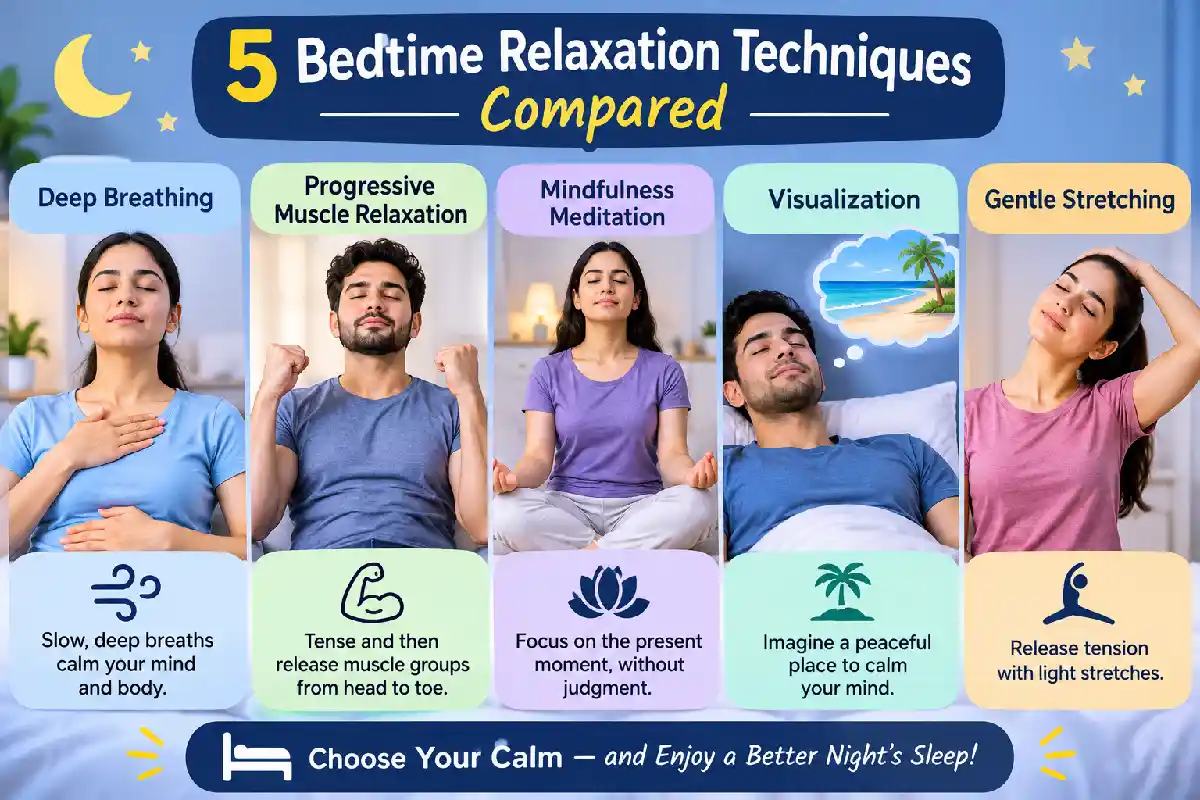


Some nights your body is tired but your mind keeps going. You replay a conversation, plan tomorrow, or feel wired for no clear reason. Relaxation techniques won’t force sleep, and nothing reliably can. What they can do is make the conditions for sleep friendlier by giving your attention somewhere calm to rest and helping your body shift out of “busy” mode.
Below are five popular approaches: how each is generally thought to work, how to try it tonight, and who it tends to suit. You don’t need all five; the goal is to find one or two that feel natural.
1. Gentle breathing
How it works: Breathing is one of the few body processes you can influence directly. Slowing your breath slightly, with the exhale a bit longer than the inhale, is widely associated with a calmer state. It may also help by giving your mind a simple, rhythmic focus instead of looping thoughts.
How to try it tonight:
1) Lie down comfortably with your hands on your belly or by your sides.
2) Breathe in through your nose at a natural, unhurried pace.
3) Breathe out slowly, as if gently fogging a window, letting the exhale run a little longer than the inhale.
4) Don’t count rigidly or hold your breath. If counting helps, try a loose rhythm of in for about four, out for about five or six.
5) Continue for a few minutes, then let your breathing return to normal.
Keep it gentle; there’s no need to breathe deeply or forcefully. If you feel dizzy, lightheaded, or short of breath, stop and breathe normally. People with respiratory or heart conditions may want to check with a clinician before practicing breathing exercises regularly.
Who it suits: Almost anyone who wants something quick, quiet, and equipment-free. It’s also useful in the middle of the night when you’d rather not reach for a device.
2. Body scan
How it works: A body scan moves your attention slowly through your body, noticing sensations without trying to change them. Many people discover tension they didn’t realize they were holding, such as a clenched jaw or raised shoulders, and it often softens once noticed. It also anchors attention in the present rather than tomorrow’s to-do list.
How to try it tonight:
1) Lie on your back or in your usual sleep position.
2) Bring your attention to your toes. Notice warmth, coolness, pressure, tingling, or nothing at all.
3) Slowly move upward through your feet, ankles, calves, knees, thighs, hips, and so on, spending a few breaths on each area.
4) Where you find tension, imagine breathing into that spot and letting it loosen, without forcing anything.
5) When your mind wanders, which it will, return to the last body part you remember. If you fall asleep before reaching your head, that’s fine.
Who it suits: People who carry stress physically, like a slow, methodical approach, or want a practice they can do silently from memory. Some people find focusing on the body uncomfortable, especially if they live with chronic pain or find bodily attention distressing. If that’s you, another technique may feel better.
3. NSDR (non-sleep deep rest)
How it works: NSDR is an umbrella term for guided practices designed to bring you into a deeply relaxed state while, in principle, staying awake. Many NSDR scripts draw on yoga nidra, combining slow breathing, body awareness, and calm verbal guidance. People often use it to recharge during the day, but it can also be a gentle wind-down at night.
To be clear, NSDR is not a replacement for sleep. It may help you feel more rested or ease the transition toward sleep, but it complements the sleep your body needs rather than substituting for it.
How to try it tonight:
1) Choose a guided NSDR or yoga nidra recording, typically ten to thirty minutes long.
2) Set your phone to do-not-disturb and lower the brightness, or place it face down once the audio starts.
3) Lie down comfortably and follow the voice through breath awareness, body awareness, and sometimes visualization.
4) Don’t worry about “doing it right.” Drifting off is common and perfectly fine at bedtime.
Who it suits: People who prefer being guided rather than directing their own attention, and those who like a structured practice with a clear beginning and end. It can also offer a short daytime reset without napping.
4. Sleep stories
How it works: Sleep stories are calm, slow-paced narratives read in a soothing voice, usually featuring gentle scenes like a train journey through countryside or a walk along a quiet beach, with little tension or plot. They give your mind something mildly interesting to follow, which can crowd out worry without being stimulating enough to keep you awake.
How to try it tonight:
1) Pick a story that sounds pleasantly dull, avoiding anything suspenseful or emotionally intense.
2) Start it once you’re in bed with the lights off or low.
3) Set a sleep timer if your audio app has one, so it doesn’t play all night.
4) Listen loosely. You don’t need to follow every detail or reach the end.
Who it suits: People whose minds race, those who grew up falling asleep to the radio or a parent’s voice, and anyone who finds silence harder than gentle background sound. If you find yourself staying awake to hear what happens next, try a blander story or a different technique.
5. Self-hypnosis
How it works: Self-hypnosis is often misunderstood. It isn’t about losing control, being “put under,” or doing anything against your will. It’s a state of focused attention combined with suggestion: you guide yourself into a calm, absorbed state, then repeat simple, positive phrases such as “my body feels heavy and comfortable.” Some people find this helps them let go of mental tension. You remain aware and can stop whenever you choose.
How to try it tonight:
1) Lie down and take a few slow, easy breaths.
2) Look at a focal point, such as a spot on the ceiling, until your eyes feel ready to close.
3) Slowly count down from ten, imagining yourself descending a staircase or sinking a little further into the mattress with each number.
4) Quietly repeat one or two gentle, present-tense suggestions, like “I’m calm and settled” or “my thoughts are slowing down.”
5) Stay with the feeling as long as you like, then let yourself drift, or count up from one to five to return to full alertness.
If you’d like guidance while learning, recordings and apps can walk you through the process. Hypnothera (https://hypnothera.ai), for example, is an AI self-hypnosis app you could explore if you prefer a guided starting point over working from memory.
Who it suits: People who respond well to imagery and words, who are curious about hypnosis, or who want to pair relaxation with gentle intentions. If you have a history of trauma, dissociation, or certain mental health conditions, it’s wise to talk with a qualified professional before using hypnosis.
How to choose
You don’t need a five-step bedtime routine; doing too much can turn relaxation into another task. A more realistic approach:
– Pick one to start. Choose whichever sounds most appealing, not most impressive.
– Give it a fair try. Use it for several nights before deciding; relaxation often gets easier with familiarity.
– Keep a backup. Many people like one device-free option, such as breathing or a body scan, for middle-of-the-night wake-ups, and one guided option for winding down.
– Match your mood. A sleep story might suit a busy-minded night, while a body scan might suit a physically tense one.
– Let go of outcomes. Trying hard to fall asleep tends to backfire. Aim to rest comfortably, and let sleep come if and when it does.
When it’s more than a restless night
These techniques are relaxation support, not treatment for persistent insomnia or other sleep disorders. If you regularly have trouble falling or staying asleep, wake feeling unrefreshed despite enough time in bed, snore loudly, gasp or stop breathing during sleep, feel very sleepy during the day, or notice sleep problems affecting your mood, work, or safety, talk to a doctor or a sleep specialist. Effective, evidence-based approaches exist, including cognitive behavioral therapy for insomnia (CBT-I), and a professional can also check for underlying causes.
In the meantime, relaxation can be one kind thing you do for yourself at the end of the day. Keep it simple, keep it gentle, and see what helps you settle.
Saba Mirza
Beauty, Fashion & Lifestyle Writer · 3+ Years Experience
Saba creates reader-friendly content covering beauty, skincare, haircare, fashion, wellness, personal care, and everyday lifestyle topics for HappyGloss.
Sameena Begum
Beauty, Wellness & Lifestyle Content Reviewer · 8 Years Experience
Sameena reviews selected HappyGloss content for clarity, structure, consistency, factual presentation, context, and overall reader usefulness.
